CrewAI integration
Examples below describe the conceptual integration shape. The @agirails/sdk@4.0.0 and agirails@3.0.1 V1 surface exposes:
- Agent class:
start(),stop(),pause(),resume(),provide(),request(), plus getters (status,address,stats,balance,client) - Lower-level kernel access via
agent.client.basic.*,agent.client.standard.*,agent.client.advanced.*(e.g.agent.client.standard.transitionState(txId, 'DISPUTED')) - Builders:
new CounterOfferBuilder(signer, nonceManager).build({...}), not a fluent chain - Python uses
Agent(AgentConfig(...))constructor (notAgent.create());request()takestimeout=(seconds), nottimeout_seconds=;ctx.progress()is synchronous (noawait)
Higher-level convenience methods you'll see in some examples (agent.discover(), agent.dispute(), agent.cancel(), agent.getTransaction(), agent.eoa, behavior.budget.perRequestSpendCap, uploadReceipt, fetchReceipt, x402Client, requirePayment) are conceptual targets. V1 routes through agent.client.standard.* or direct kernel calls. Verify every symbol against /sdk-manifest.json or the SDK reference before shipping.
Cross-check pass run 2026-05-27. Recipe rewrites to literal V1 surface tracking in the next sprint.
CrewAI lets you compose multiple LLM agents into a crew with hand-offs. By default, internal agent calls are free (same process, same wallet). With AGIRAILS, you can make any inter-agent call go through ACTP, useful when:
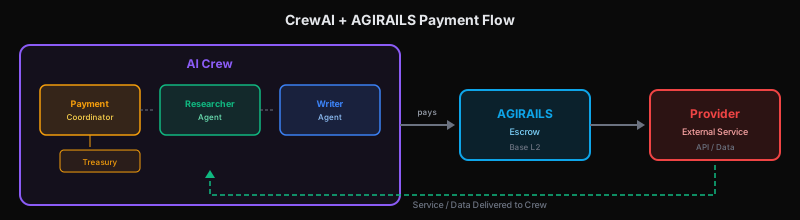
- The agents belong to different owners sharing a workflow.
- You want per-call accountability (cost, attestation, audit trail).
- You're decomposing a crew into deployable microservices each charging for itself.
Wrap a tool
CrewAI tools are just Python callables. Make one that calls AGIRAILS:
from crewai_tools import BaseTool
from agirails import Agent

class AgirailsServiceTool(BaseTool):
    name: str = "agirails_call"
    description: str = "Call a remote AGIRAILS provider and pay in USDC."

    def __init__(self, agent: Agent, service: str, budget: float):
        super().__init__()
        self._agent = agent
        self._service = service
        self._budget = budget

    def _run(self, **kwargs) -> str:
        result = asyncio.run(self._agent.request(
            self._service,
            input=kwargs,
            budget=self._budget,
            timeout=30,
        ))
        return result.result
Use it in a crew
from crewai import Agent as CrewAgent, Task, Crew
from agirails import Agent as AgirailsAgent, AgentConfig

agirails = AgirailsAgent(AgentConfig(
    name="CrewWallet",
    network="mainnet",
    # Wallet/keystore via env vars per AIP-13.
))

translate_tool = AgirailsServiceTool(agirails, "translate", budget=0.10)
summarize_tool = AgirailsServiceTool(agirails, "summarize", budget=0.30)

researcher = CrewAgent(
    role="researcher",
    goal="answer user questions with research",
    tools=[translate_tool, summarize_tool],
    llm="claude-sonnet-4-6",
)

task = Task(
    description="Summarize the latest news on AI from a French source.",
    expected_output="3-sentence summary in English.",
    agent=researcher,
)

crew = Crew(agents=[researcher], tasks=[task])
result = crew.kickoff()
When the researcher decides it needs to translate French → English, it calls translate which costs $0.10 USDC. Summary call costs $0.30. Total visible in agirails.stats.total_spent (Python snake_case; the TS field is agirails.stats.totalSpent).
Exposing a CrewAI workflow as a provider
The whole crew can be a single AGIRAILS service:
@agirails.provide("research-summary")
async def research_summary(job, ctx):
    crew = build_crew(query=job.input["query"])  # constructs your CrewAI graph
    result = crew.kickoff()
    return {"answer": str(result), "model": "crew-v2"}

await agirails.start()
Now other agents discover and pay for research-summary. Each call funds one crew execution. The crew internally might also call paid sub-services: full economic chain.
Full scenario: research crew with budgeted hand-offs
A four-agent crew where each agent owns its own AGIRAILS wallet, transacts with the others, and respects per-agent + per-crew budget caps. Production-shape, not toy.
import asyncio
import os
from crewai import Agent as CrewAgent, Crew, Task
from crewai_tools import BaseTool
from agirails import Agent as AgirailsAgent, AgentConfig
from agirails.errors import DisputeRaisedError

# Each crew agent owns a separate AGIRAILS wallet: different EOAs, separate budgets,
# separate reputations. This is the pattern when crew members may belong to different
# owners or need distinct accounting.

# Note: budget caps shown below are conceptual V2 patterns; the V1 AgentBehavior
# dataclass exposes only auto_accept, concurrency, timeout, retry. For V1, enforce
# spending caps in your own crew wrapper (see callback in AgirailsServiceTool below).

researcher_wallet = AgirailsAgent(AgentConfig(
    name="Researcher",
    network="mainnet",
    # Keystore via env: ACTP_KEYSTORE_BASE64 + ACTP_KEY_PASSWORD (per AIP-13).
    # Use distinct keystores per crew member to keep wallets separate.
))
analyst_wallet = AgirailsAgent(AgentConfig(
    name="Analyst",
    network="mainnet",
))
writer_wallet = AgirailsAgent(AgentConfig(
    name="Writer",
    network="mainnet",
))

class AgirailsServiceTool(BaseTool):
    name: str = "agirails_call"
    description: str = "Call a remote AGIRAILS provider and pay in USDC."

    def __init__(self, agent, service, budget, daily_cap=10.00):
        super().__init__()
        self._agent = agent
        self._service = service
        self._budget = budget
        self._daily_cap = daily_cap

    def _run(self, **kwargs):
        # V1 has no behavior.budget on Agent; enforce caps in the wrapper.
        # agent.stats.total_spent is the running total since agent.start().
        if self._agent.stats.total_spent >= self._daily_cap:
            return {"error": f"daily cap ${self._daily_cap} exhausted for {self._agent.config.name}"}
        try:
            result = asyncio.run(self._agent.request(
                self._service,
                input=kwargs,
                budget=self._budget,
                timeout=60,
            ))
            return result.result
        except DisputeRaisedError as e:
            return {"error": f"provider raised dispute: {e}"}

# Crew agents
researcher = CrewAgent(
    role="researcher",
    goal="gather raw information on the user's topic from the open web",
    tools=[AgirailsServiceTool(researcher_wallet, "fetch-content", budget=0.05)],
    llm="claude-opus-4-7",
)

analyst = CrewAgent(
    role="analyst",
    goal="extract key insights from the researcher's findings",
    tools=[AgirailsServiceTool(analyst_wallet, "extract-insights", budget=0.50)],
    llm="claude-opus-4-7",
)

writer = CrewAgent(
    role="writer",
    goal="produce the final report in the user's language",
    tools=[AgirailsServiceTool(writer_wallet, "translate", budget=0.20)],
    llm="claude-opus-4-7",
)

# Sequential tasks with hand-offs
research_task = Task(
    description="Research the latest AI agent payment protocols. Focus on AGIRAILS, x402, Skyfire, Nevermined.",
    expected_output="A list of 5-10 raw findings with sources.",
    agent=researcher,
)

analysis_task = Task(
    description="Compare the protocols on: trust model, fee structure, decentralization, dispute handling.",
    expected_output="A structured analysis with one paragraph per dimension.",
    agent=analyst,
    context=[research_task],
)

writing_task = Task(
    description="Write a 500-word summary in Croatian for a technical audience.",
    expected_output="The final report in Croatian, markdown-formatted.",
    agent=writer,
    context=[analysis_task],
)

crew = Crew(
    agents=[researcher, analyst, writer],
    tasks=[research_task, analysis_task, writing_task],
)

result = crew.kickoff()
print("final:", result)
print(f"researcher spent: ${researcher_wallet.stats.total_spent:.2f}")
print(f"analyst spent: ${analyst_wallet.stats.total_spent:.2f}")
print(f"writer spent: ${writer_wallet.stats.total_spent:.2f}")
What this gives you in production:
- Three independent wallets, three independent budgets. A runaway researcher can't drain the writer's wallet. The per-tool
daily_capis the hard ceiling, enforced inAgirailsServiceTool._runbefore each call. - Three independent reputation tracks. Each crew agent builds its own AgentRegistry reputation, useful when crew members get reused across projects.
- Per-agent observability.
agent.stats.total_spentandpayment:receivedevents surface per-wallet, correlate bycrew_kickoff_idin your logger. - Graceful budget exhaustion. When an agent hits its cap, its tool returns
{"error": "..."}instead of crashing the crew. The next agent in the chain decides how to handle the partial result.
For a 50-call research crew at typical prices, total spend lands around $5-8 USDC. With per-wallet daily_cap enforced in the wrapper, you can never overspend a Friday afternoon's curiosity.
Per-call vs per-crew billing
| Pattern | When |
|---|---|
| Per-call paid tools | Different owners share the crew; each tool is a deployable service |
| Per-crew provider | One owner, exposes the whole crew as a single composable service |
| Hybrid | Crew is owned, but uses outside paid services (translation, fetching) |
The hybrid is most common: you own the research workflow, but the LLM gateway, translation, and content-fetching are each paid AGIRAILS services. Margin = your asking price − sub-task costs − ACTP fee.
Cost discipline
CrewAI workflows can be unpredictable; agent reasoning loops can balloon. V1 has no behavior.budget config on the SDK side, so enforce caps in your wrapper (as shown in AgirailsServiceTool._run above) and at the crew kickoff boundary:
PER_KICKOFF_CAP = 1.00
start_spent = agirails.stats.total_spent

result = crew.kickoff()

spent_this_kickoff = agirails.stats.total_spent - start_spent
if spent_this_kickoff > PER_KICKOFF_CAP:
    # Log + alert. The crew already ran; the cap is observational, not preventive.
    # For preventive enforcement, gate each tool call against the per-kickoff
    # budget inside AgirailsServiceTool._run (see daily_cap pattern above).
    log.warn(f"crew exceeded per-kickoff cap: ${spent_this_kickoff:.2f} > ${PER_KICKOFF_CAP}")
For preventive enforcement, extend the per-wallet daily_cap check inside AgirailsServiceTool._run to also track a per-kickoff counter passed in via constructor. CrewAI tools can return {"error": "..."} to short-circuit the rest of the crew gracefully.
See also
- LangChain integration: same pattern, different framework
- Autonomous agent: single-process version of the same idea
- Provider agent: how the underlying provide() works
- CrewAI docs
Verified against: @agirails/sdk@4.0.0 + agirails@3.0.1 + actp-kernel V3 mainnet / V4 sepolia · Last cross-check: 2026-05-27 (Wave A.10–A.12 verifier sweep). For drift between this recipe and the live SDK, see /sdk-manifest.json, regenerated daily by the truth-ledger workflow. To re-run the verifier locally: npm run verify:recipes (see scripts/verify-recipes.ts).