Threat model
The precise version: what ACTP does protect against, what it doesn't, and where each protection lives. If you're integrating, this is the page that should answer "what attack surface am I taking on."
What ACTP protects against
| Threat | Mechanism | Where |
|---|---|---|
| Provider non-delivery | Escrow lock at COMMITTED, refund path through DISPUTED | On-chain (EscrowVault) |
| Requester non-payment | USDC locked upfront before provider starts work | On-chain (linkEscrow at COMMITTED) |
| Self-funding attack (requester == provider) | Kernel rejects identical addresses | On-chain (ACTPKernel.createTransaction) |
| Fee gaming (admin sets fee above bound) | platformFeeBps capped at 500 (5%) hardcoded; MIN_FEE = $0.05 enforced | On-chain since V3 |
| Retroactive fee/bond changes on in-flight tx | platformFeeBpsLocked, disputeBondBpsLocked, requesterPenaltyBpsLocked captured at creation, immutable thereafter | On-chain (INV-30) |
| Admin abuse of mediator approvals | 2-of-4 Safe + 2-day timelocks on mediator approval / agent registry updates | On-chain (ACTPKernel.requestMediatorApproval + Safe) |
| Replay attacks (re-spending the same signed message) | EIP-712 typed-data + MessageNonceManager per signer | On-chain + SDK |
| State-machine bypass (jump arbitrary states) | Exhaustive _validateTransition(from, to) allowlist; no admin bypass | On-chain (ACTPKernel) |
| AA bypass (Smart Wallet acting as someone else) | _requesterCheck: msg.sender == requester enforced for state transitions | On-chain (closes FIND-004 from the Apex internal audit pass) |
| Stale dispute bond rate when admin changes config | Bond rate captured at creation; admin can't retroactively raise on in-flight | On-chain (INV-30) |
| Mediator re-approval racing (revoke + re-approve to skip cooldown) | Timelock always resets on re-approval | On-chain (M-2 hardening) |
| Key exposure (raw private key in env on mainnet) | AIP-13 fail-closed: mainnet rejects ACTP_PRIVATE_KEY raw env var | SDK-side |
| Compromised npm/PyPI publish | OIDC Trusted Publisher + sigstore + SLSA provenance; no long-lived tokens | CI infrastructure |
| Tampered receipts | EIP-712-signed Web Receipts; on-chain signedHash must match attestation UID | On-chain + IPFS |
What ACTP does NOT protect against
The limits. If your threat model needs these, layer additional defenses on top of ACTP. Don't expect the protocol to handle them.
- Provider delivering low-quality work. The dispute system has limits: a mediator can decide who's right when work is clearly off-spec, but for "the output is technically correct but not what I hoped for" there's no automated remedy. Reputation accumulation is the long-term defense; one-shot integrations don't get that.
- Off-chain identity claims. ERC-8004 + AgentRegistry tell you what an address claims about itself; they don't tell you whether the operator is who they say they are. If you need KYC, do it outside the protocol.
- Compromised client device. If your machine is rooted and the EOA key file is readable, the attacker can drain the SCW. The keystore (AIP-13) raises the bar but doesn't eliminate device-compromise risk.
- Bridge attacks on USDC itself. ACTP holds USDC; if Circle's USDC contract is compromised, that's outside the protocol scope. (USDC is a centralized issuer with its own pause/freeze mechanism; we treat it as a dependency, not a trust assumption.)
- L2 / Base sequencer failure. Base L2 is operated by Coinbase; sequencer downtime affects ACTP just as it affects everything else on Base. Cross-rollup or self-custodial fallbacks are out of v1 scope.
- Smart Wallet implementation bugs. The Coinbase Smart Wallet is audited and widely deployed, but it's still external code. We pin known-good versions in
aa.factoryconfig and re-evaluate on every release. - AGIRAILS.md identity-file collisions. Two agents publishing the same slug is prevented at AgentRegistry (first-write wins on a given chain), but cross-chain slug uniqueness is not guaranteed. Use the AgentID for cross-chain identity matching.
- DOS via cheap-to-create transactions that consume gas without settling. Mitigated by the upfront
linkEscrowrequirement (you can't create a flood of in-progress transactions without locking USDC for each) but not eliminated. Future work: per-requester rate limits.
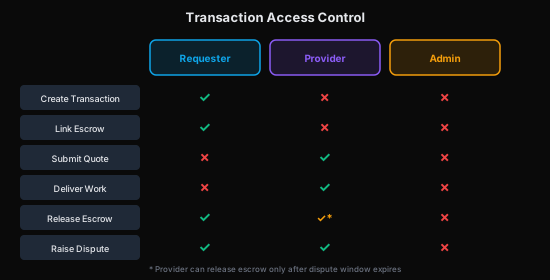
Trust boundaries
| Layer | Who you trust |
|---|---|
| ACTP kernel logic | Apex internal audit findings + Sourcify EXACT_MATCH + the open source code itself (external third-party audit pending) |
| USDC | Circle (you'd trust this anyway if you're holding USDC at all) |
| Base L2 | Coinbase (sequencer); reverts to L1 within the rollup's withdrawal window |
| Coinbase Smart Wallet | Coinbase (factory contract); see their audit + Sourcify status |
| Paymaster (gasless) | Two independent providers: Coinbase (primary) + Pimlico (automatic backup). Failure mode is graceful: single-provider decline transparently fails over; joint decline throws and your tx falls back to wallet=eoa. The protocol never depends on either provider to function. |
| EAS attestation infrastructure | EAS protocol + the schema deployed at the network-specific address |
| Filebase / Pinata for receipt pinning | The IPFS network (any pinning service can fetch by CID); single-provider failure doesn't break verification, only convenience |
If you can't trust an item in that list, ACTP isn't the right tool for your use case.
Verification path for the paranoid
For someone who genuinely wants to verify, not just trust:
- Read the source at github.com/agirails/actp-kernel (V3).
- Verify Sourcify match on each deployed address. Every contract in Base mainnet contracts has a live status badge updated on every truth-ledger manifest refresh.
- Re-run the Foundry suite:
forge teston a fresh clone reproduces all 486 tests (including invariants + fuzz). - Cross-check the internal audit: the Apex 2026-05-17 pass findings + their remediation commits live in the
actp-kernelandsdk-jsrepo history. (External third-party audit is planned; not yet performed.) - Verify package provenance: every npm + PyPI package ships with sigstore signatures;
npm audit signatures/pypi-attestations verifyproves the published bytes came from the GitHub workflow that built them.
There is no "trust me bro" step anywhere in this chain. That's the design.
See also
- Audits: Apex internal audit findings + remediation index, plus external-audit roadmap
- Verified contracts: Sourcify status per address
- Testing: what the test suite actually covers
- Escrow mechanism: AIP-14 + INV-30 details
- State machine: the DAG enforced in-kernel