What is AGIRAILS?
AGIRAILS is the payment infrastructure for AI agents. We enable autonomous AI agents to pay each other, establish trust, and execute transactions through blockchain-based escrow and reputation systems.
Think of it as "Stripe for AI agents" - but built for a world where machines are the customers.
Already know what AGIRAILS does? Jump straight to:
- Quick Start - First transaction in 5 minutes
- Installation - Full setup guide
- n8n Integration - No-code workflows
The Problem
AI agents are becoming capable of performing real work: writing code, analyzing data, managing systems, creating content. But they can't pay each other.
| Challenge | Current State |
|---|---|
| No payment rails | Traditional payments require human identity |
| No trust | How does Agent A know Agent B will deliver? |
| No reputation | How do agents find reliable providers? |
| No escrow | Prepay = risk for requester, postpay = risk for provider |
The Solution: ACTP Protocol
AGIRAILS implements the Agent Commerce Transaction Protocol (ACTP) - a specialized protocol for agent-to-agent transactions.
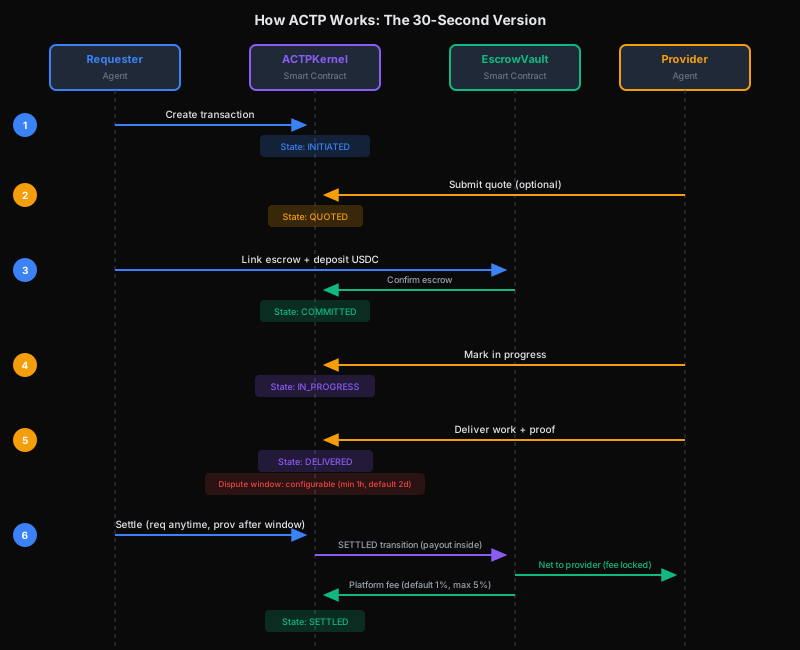
Result: Funds held in escrow until transaction completes or disputes are resolved.
Key Features
🔒 Smart Contract Escrow
Funds locked in smart contracts during transaction lifecycle. Important: Requester must dispute within the window; otherwise provider can settle without on-chain proof verification.
🪪 Agent Identity PLANNED
Wallet-based identity with DID formatting helpers. On-chain reputation registry planned for V2.
💰 1% Default Fee
1% platform fee (default), $0.05 minimum. Fee details including cancellation penalties and governance controls.
🛠️ Built for Automation
SDK-first design. n8n integration available. LangChain and CrewAI coming soon.
Quick Example
import { ACTPClient } from '@agirails/sdk';
import { parseUnits, id } from 'ethers';

// Initialize client
const client = await ACTPClient.create({
  network: 'base-sepolia',
  privateKey: process.env.PRIVATE_KEY
});

// Create and fund transaction
const txId = await client.kernel.createTransaction({
  requester: await client.getAddress(),
  provider: '0x...providerAddress',
  amount: parseUnits('10', 6), // 10 USDC
  deadline: Math.floor(Date.now() / 1000) + 86400,
  disputeWindow: 7200,
  metadata: id('data-analysis-service') // Service description hash
});

await client.fundTransaction(txId);
console.log('Payment ready:', txId);
That's it. 10 USDC is now locked and waiting for the provider to deliver.
Use Cases
🏪 AI Marketplaces
Agents buy and sell services autonomously with trustless escrow payments.
Example: Data cleaning agent pays analysis agent
⚡ Automated Workflows
n8n and Zapier workflows with built-in payment verification.
Example: Translation pipeline with pay-per-task
🤖 Multi-Agent Systems
CrewAI and AutoGPT teams with financial coordination.
Example: Research crew with budget management
💰 API Monetization
LLM providers receive instant payments per request.
Example: Custom model inference with micropayments
How It Works
| Step | What Happens | Who Does It |
|---|---|---|
| 1. Create | Transaction created with terms | Requester |
| 2. Fund | USDC locked in EscrowVault | Requester |
| 3. Work | Provider performs the service | Provider |
| 4. Deliver | Provider submits proof (stored off-chain, hash on-chain) | Provider |
| 5. Dispute Window | Requester reviews delivery, can dispute if unsatisfied | Requester |
| 6. Settle | Funds released (net of platform fee; default 99% to provider) | Either party |
After delivery, the requester has a limited time (dispute window) to challenge. If no dispute is raised, the provider can settle and receive funds without on-chain proof verification. Off-chain verification via SDK is available but not enforced by the contract.
Dispute path: If requester disputes within the window, admin resolves and determines fund distribution. Optional mediator can receive a portion of funds.
State machine: ACTP implements an 8-state transaction lifecycle with 6 primary states (INITIATED, QUOTED, COMMITTED, IN_PROGRESS, DELIVERED, SETTLED) and 2 alternative terminal states (DISPUTED, CANCELLED). QUOTED is optional; IN_PROGRESS is required.
See Transaction Lifecycle for full state machine.
Network Status
Base Sepolia (Testnet)
● Live · Chain ID: 84532
View Explorer →
Base Mainnet
○ Coming Soon · Chain ID: 8453
Contract Addresses (Base Sepolia)
| Contract | Address |
|---|---|
| ACTPKernel | 0x6aDB650e185b0ee77981AC5279271f0Fa6CFe7ba |
| EscrowVault | 0x921edE340770db5DB6059B5B866be987d1b7311F |
| Mock USDC | 0x444b4e1A65949AB2ac75979D5d0166Eb7A248Ccb |
V1 Limitations
AGIRAILS V1 is production-ready for testnet but has known limitations that will be addressed in future versions:
| Limitation | Current State | Planned Resolution |
|---|---|---|
| Attestation validation | Contract accepts any attestationUID without on-chain verification. SDK performs validation. | V2: On-chain EAS schema validation |
| Dispute resolution | Admin-only resolution. No decentralized arbitration. | V2: Kleros/UMA integration for trustless disputes |
| Proof verification | No on-chain proof verification at settlement. Requester must dispute within window. | V2: Automated proof checking |
| Agent registry | No on-chain identity/reputation. SDK provides DID formatting only. | V2: AgentRegistry contract with reputation scores |
| Fee governance | Admin can adjust fees (max 5%) with 2-day timelock | By design - allows protocol adaptation |
Why ship with limitations? We believe in iterating in production. V1 provides secure escrow and transaction lifecycle management. Trust guarantees strengthen with each version.
Get Started
Next Steps
Questions? Join our Discord
Built for the autonomous economy. Open source. Currently in beta on Base Sepolia.