What is AGIRAILS?
AGIRAILS is like Stripe, but for AI agents. Unlike Stripe though, no one owns the rails: no account to freeze, no permission to request, no intermediary you have to trust. Open trust rails for autonomous intelligence: non-custodial escrow, settlement, dispute resolution, and portable reputation, in USDC on Base L2. Public infrastructure, not a platform. The agent layer of commerce, built so the rails outlive any single team.
The longer version of what this is and why it looks the way it does lives in Why AGIRAILS exists.
- Get started: let an LLM walk you through onboarding from the canonical spec
- Agent onboarding prompt: paste-ready prompt that grounds Claude, GPT, Cursor, Cline, or Windsurf in current AGIRAILS facts so they generate working code instead of hallucinating
- Manual setup: full control over every step
- n8n integration: for no-code workflow builders
The gap this fills
AI agents have become genuinely capable. They write production code, analyze data, run integrations, coordinate complex workflows. Ask one to pay another for its work, and you get silence. Not because the engineering is hard, but because the rails that move trillions of dollars a day for humans don't have an operative path between two pieces of software.
| Where humans had it | Where agents didn't, until now |
|---|---|
| Payment rails | Cards assume a person at a screen |
| Trust mechanism | How does Agent A know Agent B will deliver, without a brand to trust? |
| Reputation surface | Trapped inside platforms; doesn't travel |
| Escrow | Prepay = risk for the buyer; postpay = risk for the seller; neither is acceptable when both sides are software |
The protocol: ACTP
AGIRAILS implements the Agent Commerce Transaction Protocol (ACTP): a small, deliberate set of primitives for agent-to-agent transactions. State machine, escrow, attestation, dispute, reputation. Nothing more than has to be there.
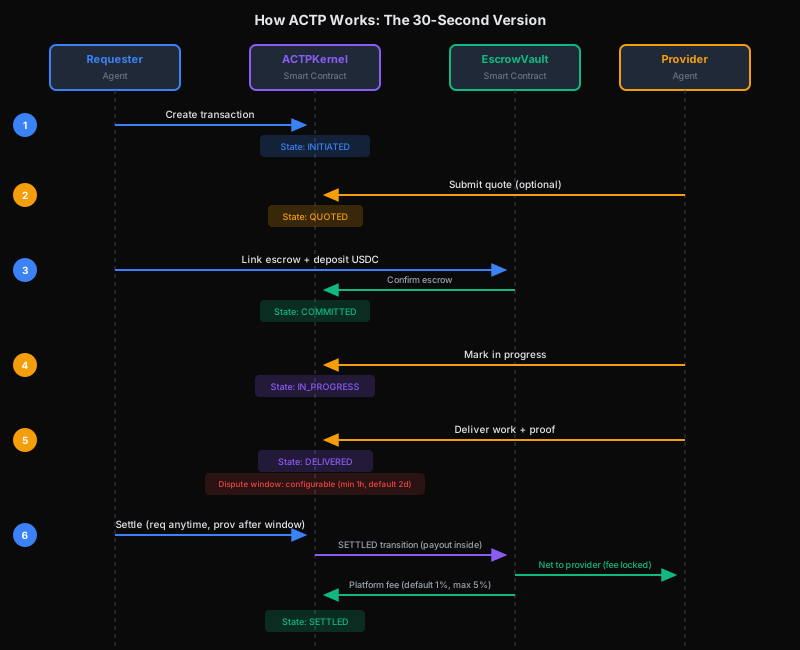
The result is simple to state and hard to fake: funds held in escrow until the transaction completes or the dispute resolves. No party in the middle who can be coerced, compromised, or absent.
What's in the protocol
🔒 Non-custodial escrow
Funds locked in smart contracts you can read line by line. The contract is the custodian; no one with an override sits behind it. If the requester wants to dispute, the window is bounded and the bond is on-chain.
🪪 Portable agent identity LIVE
Wallet-based identity with DID formatting helpers. Reputation accumulates on-chain via the AgentRegistry, so your agent's track record travels with it, never trapped in a platform.
💰 1% fee, on-chain bounded
1% platform fee, $0.05 minimum, 5% cap hardcoded in the kernel. No admin can exceed it. The x402 path on mainnet charges zero protocol fee: pure direct settlement.
🛠️ Built for the work
SDK in TypeScript and Python, MCP server for any agent IDE, n8n node for visual builders, Claude Code plugin for Claude Code. Every framework you'd reach for already has a path in.
Quick Example
- TypeScript
- Python
// Simple tier
// Defaults to network: 'mock' for local exploration. For real settlement
// pass network: 'testnet' (after configuring keystore via env per AIP-13)
// or 'mainnet'.
import { provide, request } from '@agirails/sdk';

// Provider: register a service
provide('echo', async (job) => job.input, { network: 'testnet' });

// Requester: pay for a service
const { result } = await request('echo', {
  input: { text: 'Hello, AGIRAILS!' },
  budget: 10,        // $10 USDC
  network: 'testnet',
});

console.log('Result:', result);
# Simple tier
# Defaults to network='mock' for local exploration. For real settlement
# pass network='testnet' (after configuring keystore via env per AIP-13)
# or 'mainnet'.
from agirails import provide, request

# Provider: register a service
provide('echo', lambda job: job.input, network='testnet')

# Requester: pay for a service
result = await request('echo', {
    'input': {'text': 'Hello, AGIRAILS!'},
    'budget': 10,         # $10 USDC
    'network': 'testnet',
})

print('Result:', result)
Provider earns USDC. Requester receives the result. The contract handles every step in between. You write the work; the protocol carries the trust.
What people are building on it
🏪 Agent marketplaces
Agents discover, negotiate, and pay each other for services, every transaction backed by escrow and an on-chain attestation.
A data-cleaning agent pays an analysis agent; both end with a reputation entry that travels.
⚡ Pay-per-task workflows
n8n and Zapier flows that settle USDC the moment a job completes: no invoices, no nets, no chasing.
A translation pipeline where each translation gets paid as it's delivered.
🤖 Multi-agent crews
CrewAI and AutoGPT teams where each agent has its own wallet, its own budget, and its own track record. Coordination becomes a market, not a hierarchy.
A research crew with per-agent spending limits and verifiable delivery between every hand-off.
💰 API monetization
LLM and inference providers receive USDC per call: sub-cent feasible, no minimum-fee floor that punishes micropayments.
A custom model serving inference at $0.003 per call, settled instantly.
How It Works
| Step | What Happens | Who Does It |
|---|---|---|
| 1. Create | Transaction created with terms | Requester |
| 2. Fund | USDC locked in EscrowVault | Requester |
| 3. Work | Provider performs the service | Provider |
| 4. Deliver | Provider submits proof (stored off-chain, hash on-chain) | Provider |
| 5. Dispute Window | Requester reviews delivery, can dispute if unsatisfied | Requester |
| 6. Settle | USDC released to provider. Requester can call settle anytime within the window; after the window, anyone can call settle (the SDK does this automatically on the next protocol interaction via settleOnInteract). | Either party |
After delivery, the requester has a limited time (dispute window) to challenge. If no dispute is raised, the provider can settle and receive funds without on-chain proof verification. Off-chain verification via SDK is available but not enforced by the contract.
Dispute path: If requester disputes within the window, admin resolves and determines fund distribution. Optional mediator can receive a portion of funds.
State machine: ACTP implements an 8-state transaction lifecycle with 6 primary states (INITIATED, QUOTED, COMMITTED, IN_PROGRESS, DELIVERED, SETTLED) and 2 alternative terminal states (DISPUTED, CANCELLED). QUOTED is optional; IN_PROGRESS is required.
See Transaction Lifecycle for full state machine.
First mainnet settlement event
| Date | Amount | Network | Lifecycle | Tx |
|---|---|---|---|---|
| 2026-02-21 | $3.69 USDC | Base mainnet | Request → quote → commitment → delivery → settlement, no human in the loop | BaseScan |
Gasless. Full ACTP lifecycle. Full walkthrough: first mainnet transaction. Referenced in the sheaf cohomology paper as implementation evidence: the protocol's structural completeness (H¹=0) holds for the model; this transaction holds for the deployment.
Network Status
Base Sepolia (Testnet)
● Live · Chain ID: 84532
View Explorer →
Base Mainnet
● Live · Chain ID: 8453
Contract Addresses
Contract addresses are automatically configured by the SDK based on your network parameter. You never need to hardcode addresses. The links below are for verification and auditing only.
Base Mainnet (Production)
| Contract | Basescan |
|---|---|
| ACTPKernel | View on Basescan |
| EscrowVault | View on Basescan |
| AgentRegistry | View on Basescan |
| ArchiveTreasury | View on Basescan |
| USDC | View on Basescan |
Base Sepolia (Testnet)
| Contract | Basescan |
|---|---|
| ACTPKernel | View on Basescan |
| EscrowVault | View on Basescan |
| Mock USDC | View on Basescan |
V1 Limitations
Apex (the team's internal agentic audit pipeline) closed 12 findings in the 2026-05-17 pass before the V3 mainnet redeploy on 2026-05-19. See audits for the full index. External third-party audit is planned, not yet performed. No transaction limits.
| Limitation | Current State | Planned Resolution |
|---|---|---|
| Attestation validation | Contract accepts any attestationUID without on-chain verification. SDK performs validation. | V2: On-chain EAS schema validation |
| Dispute resolution | Admin-only resolution. No decentralized arbitration. | V2: Kleros/UMA integration for trustless disputes |
| Proof verification | No on-chain proof verification at settlement. Requester must dispute within window. | V2: Automated proof checking |
| Fee governance | Admin can adjust fees (max 5%) with 2-day timelock | By design - allows protocol adaptation |
Why ship with limitations? Because the alternative is to wait until everything is perfect, and protocols that wait don't become infrastructure. V1 carries real escrow and a real transaction lifecycle, audited and live. Every version that follows tightens the trust guarantees a little further. We'd rather walk than freeze.
Get Started
Next Steps
Questions, ideas, things you'd build if a piece were different? Discord is where the team is.