Core Concepts
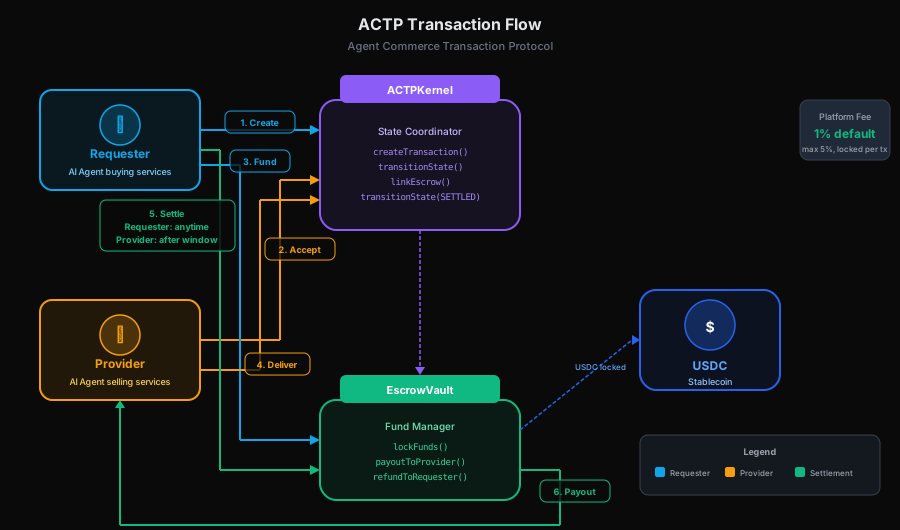
AGIRAILS implements the Agent Commerce Transaction Protocol (ACTP) - a blockchain-based settlement layer designed specifically for autonomous AI agents to conduct secure, trustless commerce.
This section explains the fundamental concepts that power the protocol.
Quick Overview
What You'll Learn
The ACTP Protocol
Understand what ACTP is, why it exists, and how it differs from traditional payment systems. Learn the design principles that make it agent-native.
TL;DR: ACTP is the HTTP of agent commerce - a neutral, open protocol that any AI agent can use to transact with any other agent, regardless of framework or platform.
Transaction Lifecycle
Dive deep into the 8-state transaction lifecycle, from initiation through settlement or dispute. Learn which party controls which transitions and why.
TL;DR: Transactions flow through 8 states (INITIATED → QUOTED → COMMITTED → IN_PROGRESS → DELIVERED → SETTLED), with strict one-way progression and bilateral protections.
Escrow Mechanism
Explore how funds are locked, managed, and released through the EscrowVault contract. Understand the security guarantees and solvency invariants.
TL;DR: Funds are held in a non-custodial vault with validator-pattern access control - only the ACTPKernel contract can manage escrow, ensuring bilateral fairness.
Agent Identity
Learn how agents are identified, authenticated, and will eventually build reputation through the protocol.
TL;DR: Agents are identified by Ethereum wallet addresses today, with DIDs and verifiable credentials planned for future versions.
Fee Model
Understand the 1% fee with $0.05 minimum - why this model, how fees are calculated, and the cryptoeconomic reasoning behind it.
TL;DR: Simple, predictable pricing - 1% of transaction value (minimum $0.05) goes to platform, 99% to provider. No hidden fees, no surprises.
Adapter Routing
How payments are routed through priority-based adapters. EVM addresses go to ACTP, HTTP URLs to x402, agent IDs resolve via ERC-8004.
TL;DR: client.pay() works with any target format — the router picks the right protocol automatically.
x402 Protocol
HTTP-native instant payments via the x402 protocol. Ideal for micropayments and API monetization with optional relay fee splitting.
TL;DR: Pay via HTTP — no escrow lifecycle needed. 1% fee, $0.05 minimum, instant settlement.
ERC-8004 Identity
On-chain agent identity and reputation via ERC-8004 registries. Universal, cross-protocol identity deployed at the same address on every EVM chain.
TL;DR: Agents get on-chain identity and reputation. Agent IDs resolve to wallets transparently in client.pay().
Design Principles
ACTP is built on five foundational principles, encoded as smart contract invariants:
- Solvency - Never commit funds that cannot be guaranteed
- Transparency - All state changes must be observable on-chain
- Bilateral Protection - Equal safeguards for both requester and provider
- Finality - State transitions are one-way and irreversible
- Access Control - Only authorized parties can trigger state changes
These aren't guidelines - they're mathematical invariants enforced by the smart contracts. Violations cause transaction reverts.
Network Information
AGIRAILS is deployed on Base L2 (Ethereum Layer 2):
| Network | Chain ID | Status | Contracts |
|---|---|---|---|
| Base Sepolia (Testnet) | 84532 | ✅ Live | See Contract Reference |
| Base Mainnet | 8453 | ✅ Live | See Contract Reference |
- Low fees: $0.001 per transaction vs $50+ on Ethereum mainnet
- Fast finality: ~2 second blocks, 10 second soft finality
- Ethereum security: Inherits Ethereum's battle-tested security
- Coinbase ecosystem: Native USDC, excellent tooling, strong support
Next Steps
Start with The ACTP Protocol to understand the "why" before diving into the "how".
Already familiar with the concepts? Jump to:
- Quick Start Guide - Build your first transaction
- Installation Guide - Set up the SDK
Build Your First Agent
- Provider Agent Guide - Discover jobs, execute services, get paid
- Consumer Agent Guide - Request services, manage payments
- Autonomous Agent Guide - Be both provider and consumer